 English
 Nederlands
 German
 Français

Chelating shampoo and chelating treatment: removing hard-water metals from hair
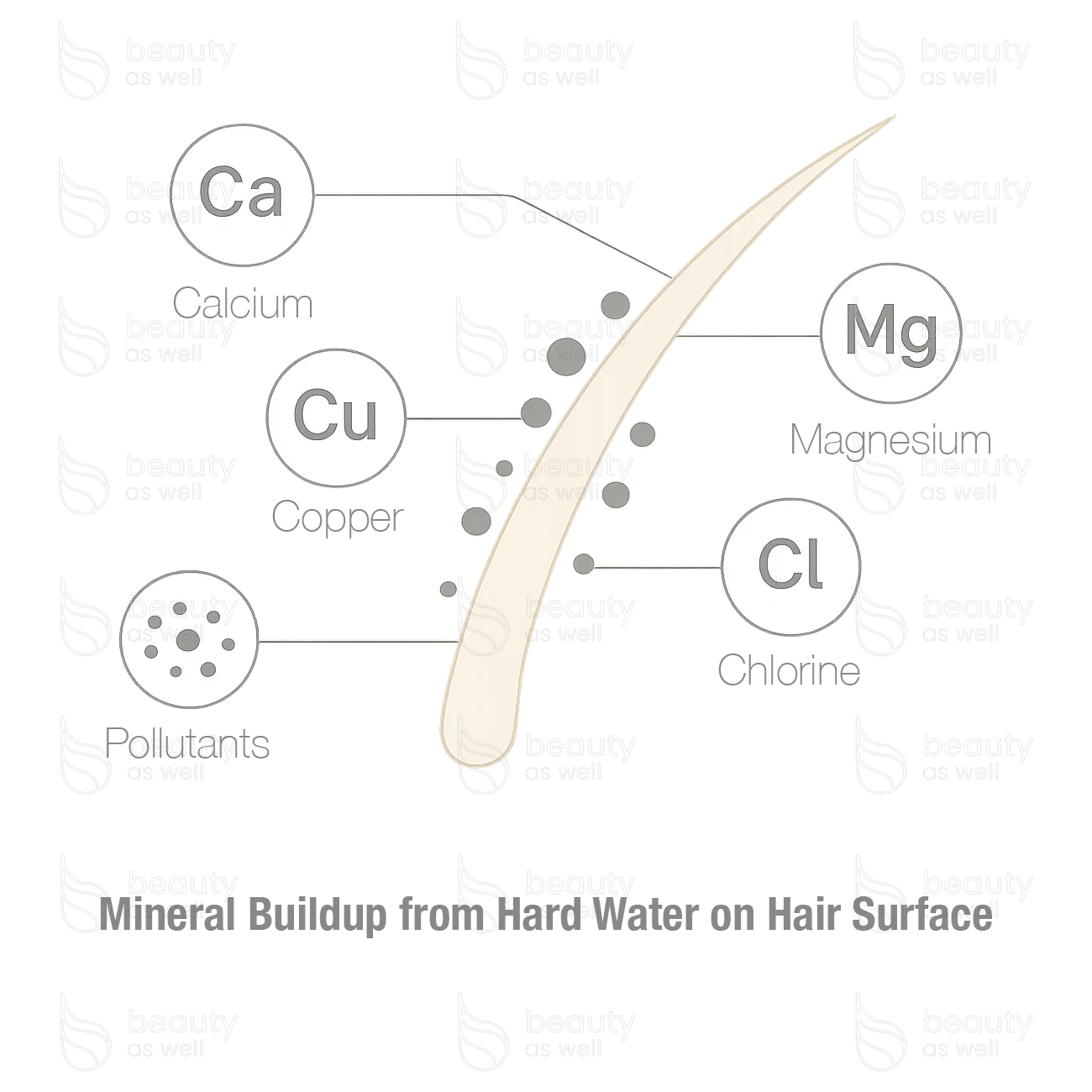
Every wash, swim or splash in hard water leaves microscopic minerals and metal ions on and inside the hair fibre. Over time these deposits build a dull film, block moisture and interfere with colouring, lightening and smoothing or keratin treatments. A chelating shampoo and a chelating treatment solve the root cause: they bind calcium, magnesium, copper and iron so the metals rinse away cleanly.
This guide explains chelation in plain language, answers the hard-water questions clients ask, and shows the OLAPLEX products we stock for it: the OLAPLEX Broad Spectrum Chelating Treatment and No. 4C.
What is a chelating shampoo, and what is a chelating treatment?
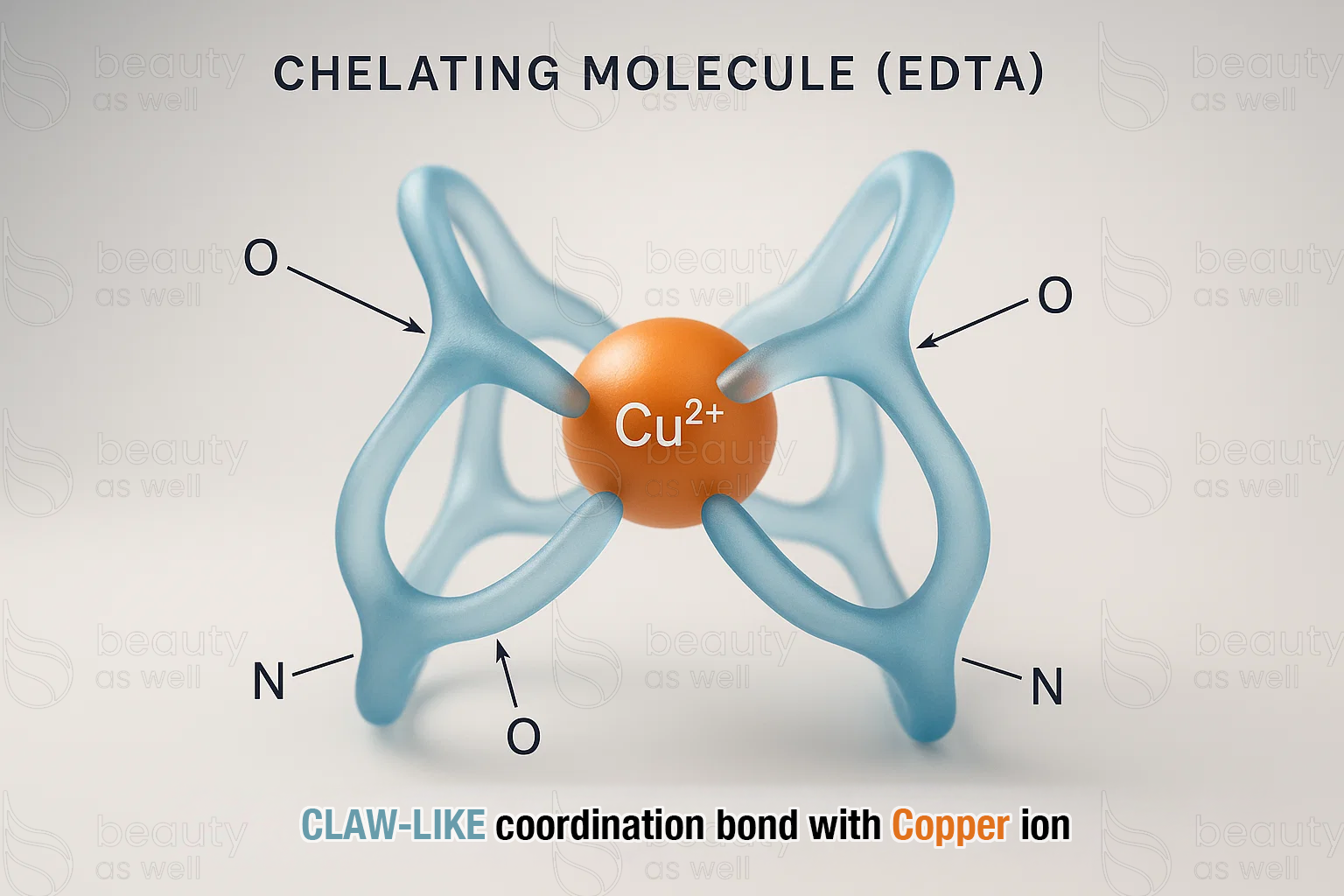
The word chelation comes from the Greek chele, claw. In cosmetic chemistry a chelating agent grips a metal ion at several binding points and forms a stable, water-soluble complex that rinses off the hair. Chelators such as EDTA, MGDA, EDDS and citric acid target the common ions, calcium, magnesium, copper and iron, and neutralise their reactivity so they can be removed during rinsing.
A chelating shampoo carries these agents in a cleansing base, for regular maintenance. A chelating treatment is a concentrated professional step with a longer processing time, for deep removal before a chemical service. Both do three things:
- Remove the invisible mineral film that blocks conditioners and masks.
- Reduce metal-catalysed oxidation during colour or bleach, for truer results.
- Bring back softness and shine in hard-water conditions.
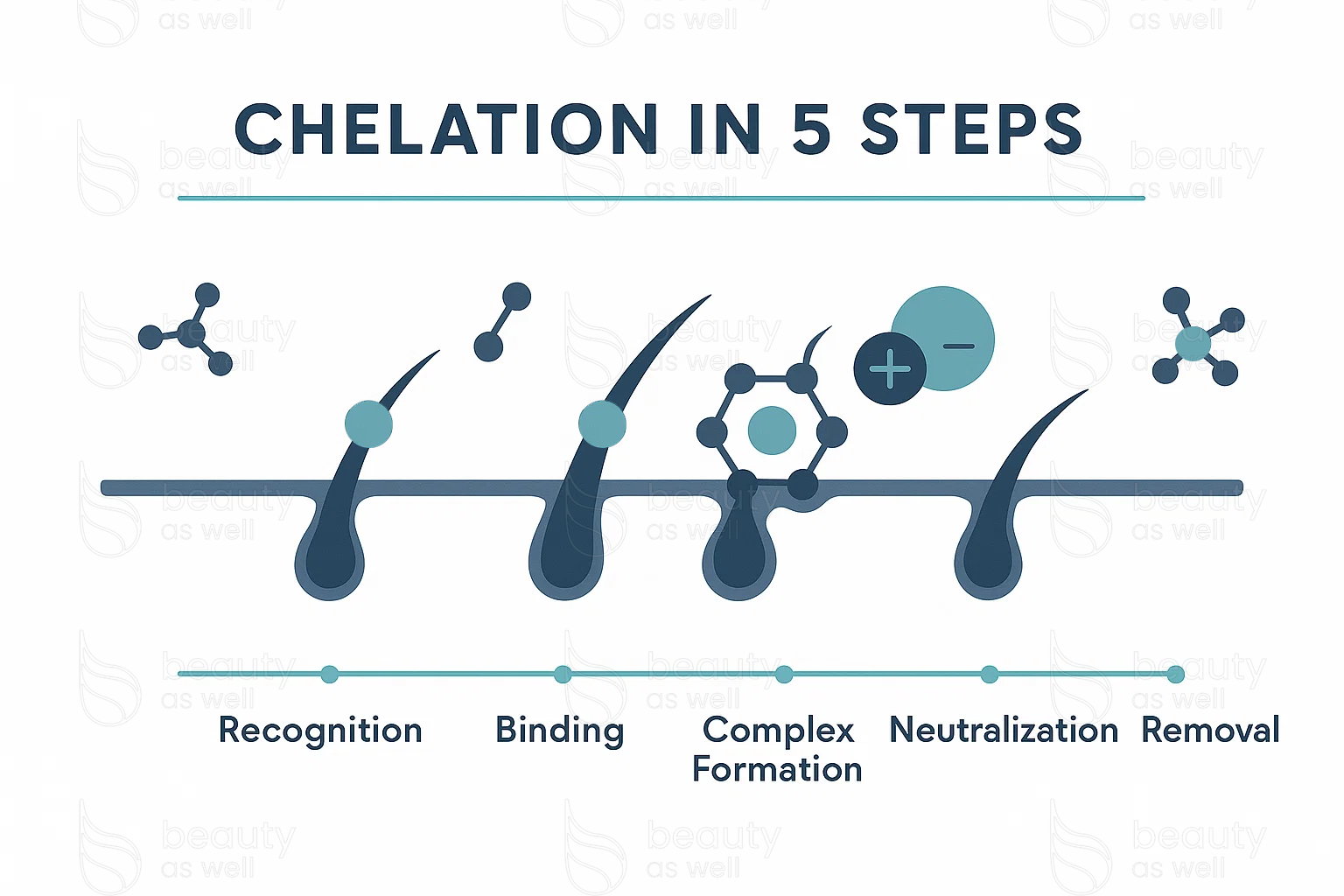
How chelation works: the science in five steps
Chelating agents contain multiple donor sites (ligands) that coordinate to a single metal ion. The sequence is recognition, binding, complex formation and removal by rinsing.
Copper and iron matter most: they catalyse free-radical reactions that fade colour and damage proteins. By binding these ions, chelating agents reduce oxidative stress and make salon services more predictable.
Chelating vs clarifying shampoo: what is the difference?
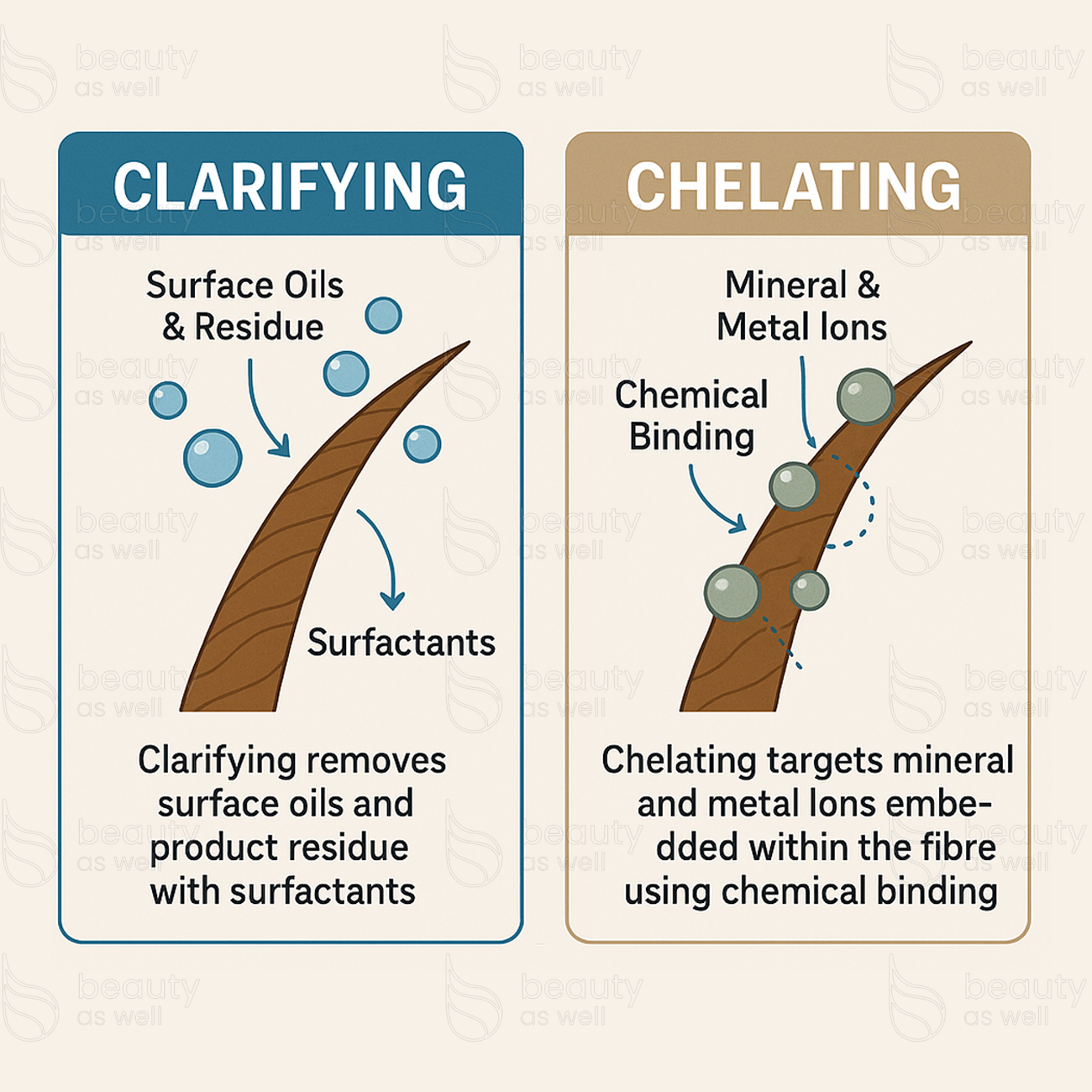
Clarifying removes surface oils and product residue with surfactants. Chelating targets the mineral and metal ions embedded within the fibre with chemical binding. Clarifying is for product build-up; chelating is the step for hard water, pre-colour preparation and green or brassy casts.
What does hard water do to your hair?
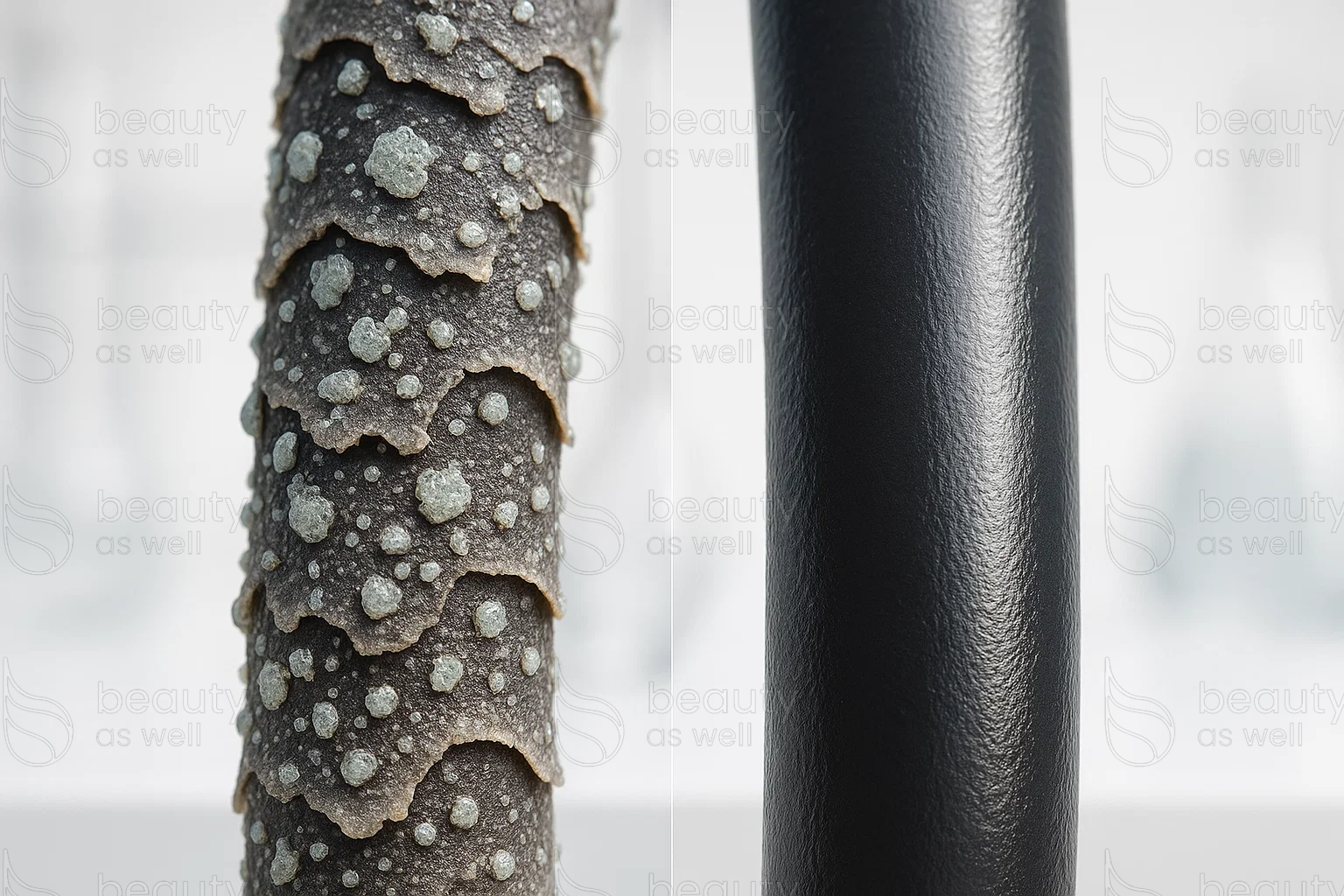
Calcium and magnesium from hard water form stubborn films that make hair feel rough and block conditioning. Copper from pools or pipes and iron from plumbing accelerate oxidation, which leads to colour fade, green or brassy casts and more breakage. Removing these ions leaves a cleaner hair surface and lets care products penetrate evenly.
Does hard water make hair greasy or heavy?
What feels greasy is often not sebum but the mineral film: hair feels coated, conditioner does not absorb, products stop working, and fine hair loses volume under weighty deposits. More shampoo does not remove a mineral film; a chelating shampoo does, and afterwards conditioners and masks penetrate again.
Is hard water bad for coloured and blonde hair?
Copper and iron catalyse the free-radical reactions that fade colour and damage proteins during oxidative services. On blonde or lightened hair the copper shows as a green cast and iron as brassiness; on colour-treated hair as uneven tone and fast fade. This is why chelating before colour gives truer, more predictable results.
Swimmers: chlorine, copper and green hair
Pool water combines chlorine with copper, and the copper deposits on lightened hair as the well-known green cast. For clients who swim often, a chelating shampoo is the swimmers' shampoo; our advice is to chelate before any colour or lightening service.
Signs your client's hair needs chelating
- Dullness Loss of shine, or a coated feel.
- Colour problems Green or brassy tones, uneven colour, or fast fade.
- Products stop working Conditioner does not absorb.
OLAPLEX Broad Spectrum Chelating Treatment
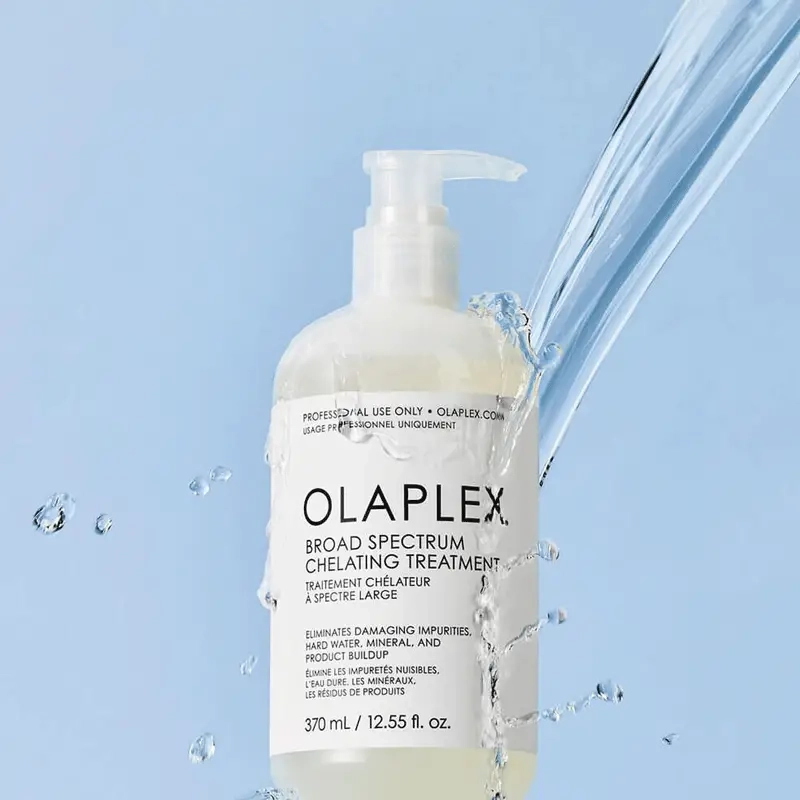
We stock the OLAPLEX Broad Spectrum Chelating Treatment. For application, processing time and how often to use it, follow the directions on the pack. More on the OLAPLEX range in our OLAPLEX bond-building guide.
OLAPLEX No. 4C: Bond Maintenance Clarifying Shampoo
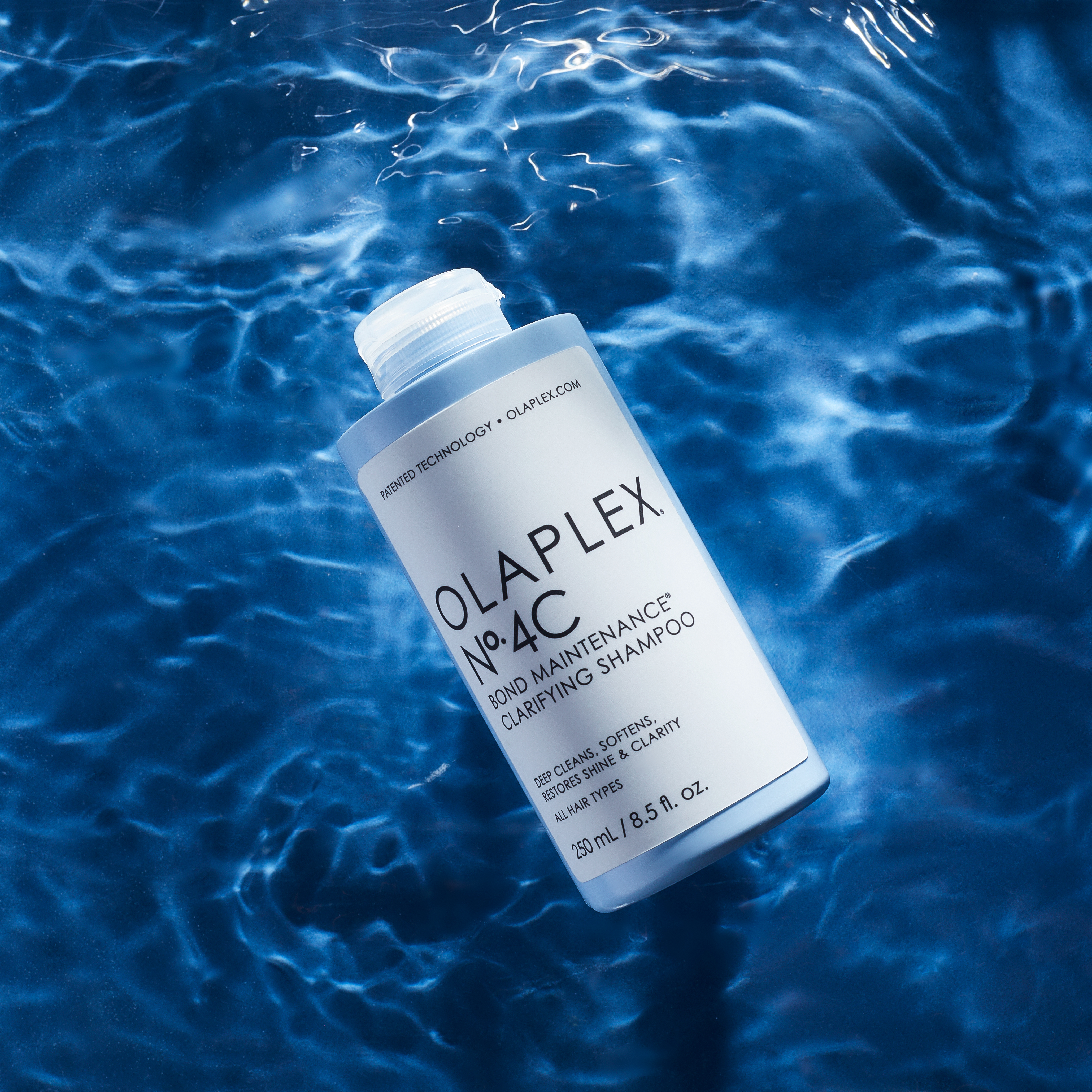
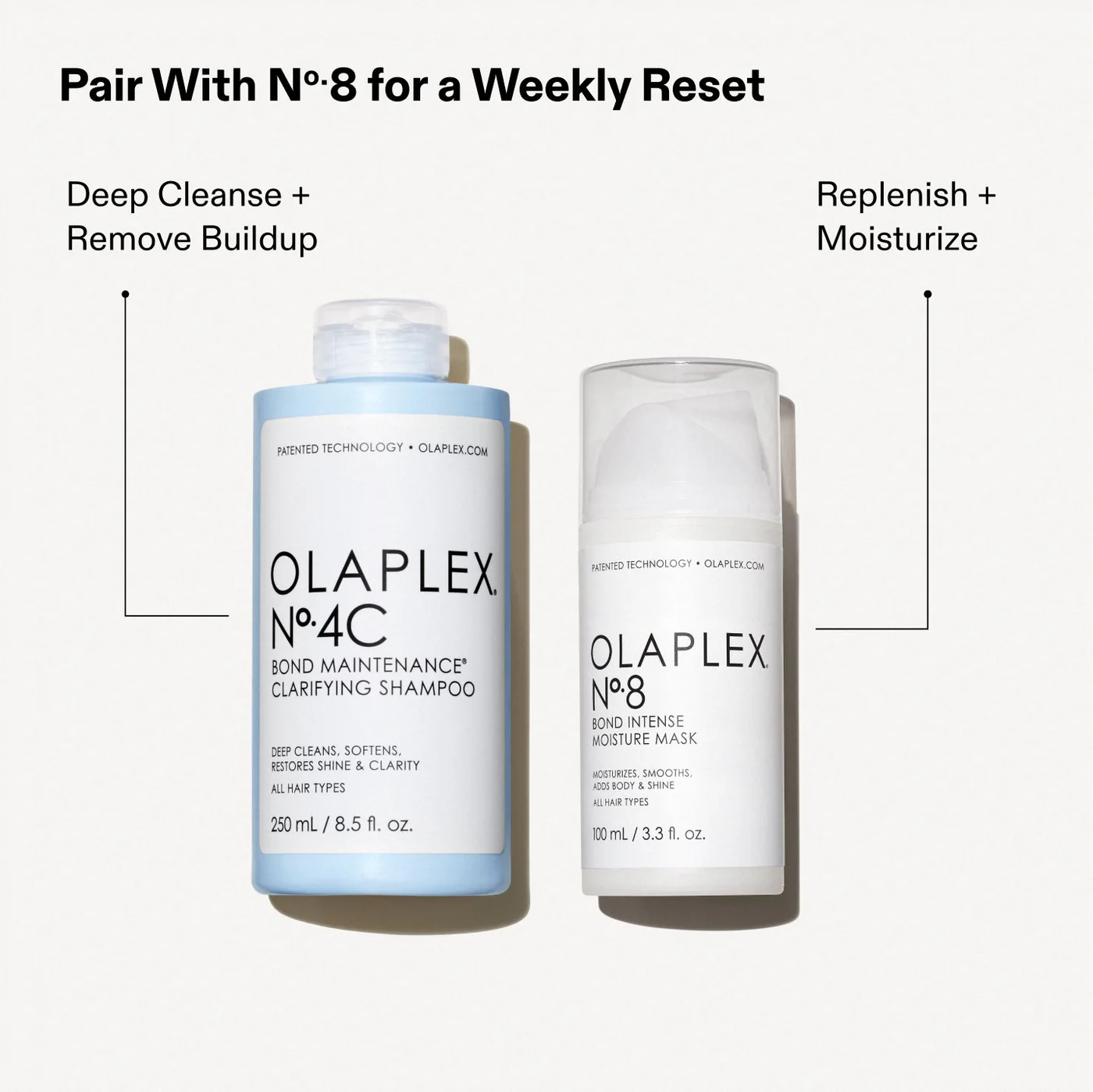
For the home routine between salon visits we recommend OLAPLEX No. 4C Bond Maintenance Clarifying Shampoo (250 mL). Its label reads “DEEP CLEANS, SOFTENS, RESTORES SHINE & CLARITY” and “ALL HAIR TYPES”. It is also available as a 1000 ml bottle.
At-home maintenance between salon visits
- A clarifying wash between visits Our advice: more often with very hard water or frequent swimming, never daily.
- Always condition afterwards to reseal the cuticle.
For your client's home routine we stock OLAPLEX No. 4C, and for the conditioning step after it OLAPLEX No. 5 Bond Maintenance Conditioner or OLAPLEX No. 8 Bond Intense Moisture Mask.
Chelating for blonde, coloured, curly and fine hair
How often should you chelate?
Our advice: in the salon, chelate before every chemical service. Before a smoothing or keratin service the same rule applies; our taninoplastia guide and the formaldehyde-free keratin guide both start from a clean, mineral-free fibre. For colour or lightening after chelating, the pack of OLAPLEX No. 1 Bond Multiplier names its place itself: “MIX WITH LIGHTENER, COLOUR, OR CHEMICAL SERVICES”. At home: a clarifying wash between visits, more often for very hard water or frequent swimming, never daily.
Frequently asked questions
Chelation is hair science, not just a deep clean: take the metals and minerals that drive dullness and chemical unpredictability out of the fibre, and colour and smoothing services become more predictable. The full range is on the OLAPLEX brand page; professional products under OLAPLEX Professional.
References
Peer-reviewed literature
- Srinivasan, G., & Srinivasan, S. (2014). Effects of hard water on hair. International Journal of Trichology, 6(3), 137-139. doi:10.4103/0974-7753.139078
- Luqman, M. W., Ramzan, M. H., Javaid, U., Ali, R., Shoaib, M., & Luqman, M. A. (2018). To evaluate and compare changes in baseline strength of hairs after treating them with deionized water and hard water and its role in hair breakage. International Journal of Trichology, 10(3), 113-117. doi:10.4103/ijt.ijt_115_16
- Srinivasan, G., & Chakravarthy Rangachari, S. (2016). Scanning electron microscopy of hair treated in hard water. International Journal of Dermatology, 55(6), e344-e346. doi:10.1111/ijd.13141
- Yang, F., Zhang, Y., & Rheaume, M. (2015). The role of chelating agents and amino acids in preventing free radical formation in bleaching systems. Free Radical Research, 49(11-12), 1408-1418. doi:10.3109/10715762.2015.1087643
- Marsh, J. M., Davis, M. G., Blalock, J. S., Scott, A. E., Harding, C. R., & Ismaeli, H. A. (2015). Preserving fiber health: reducing oxidative stress throughout the life of the hair fiber. International Journal of Cosmetic Science, 37(Suppl 2), 16-24. doi:10.1111/ics.12285
- Naqvi, K. R., Marsh, J. M., Godfrey, S., Davis, M. G., Flagler, M. J., Hao, J., & Chechik, V. (2013). The role of chelants in controlling Cu(II)-induced radical chemistry in oxidative hair coloring products. International Journal of Cosmetic Science, 35(1), 41-49. doi:10.1111/j.1468-2494.2012.00755.x
- Zhang, X., Niu, L., Gao, Z., Zhao, L., Liu, Q., Pan, L., & Liu, G. (2016). Trace metal ions in hair from frequent hair dyers in China and the associated effects on photo-oxidative damage. Journal of Photochemistry and Photobiology B: Biology, 156, 1-7. doi:10.1016/j.jphotobiol.2015.12.027
- Marsh, J. M., Gray, J., & Tosti, A. (2009). Copper and calcium uptake in colored hair. Journal of Cosmetic Science, 60(4), 479-480. doi:10.1111/j.1468-2494.2009.00522.x
- Oviedo, C., & Rodriguez, J. (2003). EDTA: The chelating agent under environmental scrutiny. Quimica Nova, 26(6), 901-905. doi:10.1590/S0100-40422003000600020
- Sebetic, K., Sjerobabski Masnec, I., Cavka, V., Biljan, D., & Krolo, I. (2008). UV damage of the hair. Collegium Antropologicum, 32(Suppl 2), 163-165. PMID 19138021
- Trueb, R. M. (2015). Oxidative stress in ageing of hair. International Journal of Trichology, 7(3), 94-100. doi:10.4103/0974-7753.167266
- Gavazzoni Dias, M. F. (2015). Hair cosmetics: An overview. International Journal of Trichology, 7(1), 2-15. doi:10.4103/0974-7753.153450
- Catala, A., Gonzalez, V., Romani, J., & Agusti-Mejias, A. (2022). Pseudo green hair. Indian Journal of Dermatology, 67(2), 215-217. doi:10.4103/ijd.ijd_880_21
- Luqman, M. W., Ali, R., Khan, Z., Ramzan, M. H., Hanan, F., & Javaid, U. (2017). Effect of topical application of hard water in weakening of hair in men. International Journal of Trichology, 9(1), 165-166. doi:10.4103/ijt.ijt_4_17
Cosmetic chemistry and formulation
Cosmetics & Toiletries (2014), Deciphering chelating agent formulas, 129(11); Personal Care Products Council (2024), wINCI, definition of chelating and sequestering agents; SpecialChem (2024), Disodium EDTA (chelating agent), cosmetic ingredient database; National Center for Biotechnology Information (2024), PubChem compound summary CID 6049, ethylenediaminetetraacetic acid.
Water quality and hard-water research
U.S. Geological Survey (2023), Water hardness and alkalinity, National Water Quality Assessment Project; World Health Organization (2011), Hardness in drinking-water, background document for the WHO Guidelines for Drinking-water Quality, WHO/HSE/WSH/10.01/10/Rev/1; TRI Princeton (2023), Aqua-mane-ia: the science and art of water on your hair.